My curiosity was raised by three words scratched on the empty shop window. “It’s not Tesco,” was a nicely enigmatic teaser which turns out to be true. The food store about to open in Canonmills is a very different kind of business.
“We won’t be any competition to Tesco,” says Dirk Douglas, one of the directors of Earthy Foods and Goods. Hard to tell over the phone but the comment sounds deadpan. Even so it’s a big, bold move for the organic food business which opened in a former wine store in Edinburgh’s Southside in May 2008. A small company set on growing slowly and surely has found itself taking a big step across the city because the opportunity came up. Just down the hill from Tesco.
Last year they opened their second store, Earthy Porty, in Portobello which now also serves as company HQ. But they’d had their eye on the Canonmills site for a couple of years and when the back-end lease came up recently they jumped at the chance.
“It an ideal site with a high-profile,” says Dirk, “a high street shop without being on the high street if you see what I mean.”
Quite apart from the surrounding economic gloom, the site has advantages and disadvantages: overlooking the Water of Leith but overshadowed by who-knows-when plans for a controversial property development which gained planning permission despite strong local opposition.
I’ve lived here long enough to remember an odd succession of businesses occupying the low-lying building that sits at a junction between Broughton, Stockbridge and Inverleith. The old ship’s chandlers with adjoining real ale shop became an uncomfortable looking outfitters specialising in kilts and evening wear. That didn’t last too long. Then Dionika got off to a good start with a thriving restaurant and deli but, sadly, seemed to run out of steam and customers.
The site looked blighted. Indian take-away moved to premises across the road but when the owner of the fireplace store decided to retire… along came Earthy. And that sounds like thoroughly good news for the area. Food and cafe culture seem to have developed some resilience to recession – when price, quality and location are right. (Although the Starbucks effect can be devastating as recent closure of Always Sunday in the Royal Mile shows).
Earthy, you might like to know, stands for Ethics, Appreciation, Respect (for environment and for people), Trustworthy, Hardworking… and Young at heart. If that sounds far-fetched you just have to meet the team behind the business to see that they mean it.
In fact I met Dirk Douglas and some ofthe team a couple of years ago when I was on a copy-writing assignment for a Glasgow PR. I went back to the store as a customer a few times – I liked the mix of seasonal food, local produce and friendly self-confidence, but going to the Southside on a shopping trip really meant taking the car and that kind of undermined the environmental benefits of buying local, seasonal food.
“A lot of our customers were asking, when can you come to Broughton? A lot more visit our website and ask can you come to Stockbridge? Come to Leeds!” For now, though, the move to Canonmills is enough. All being well Earthy – food store, take-away café and licensed restaurant – opens in early April.
Music, provided by our minstrels Anny and Dougal of RadioMagnetic, is Quantic – Mishaps Happening (Tru Thoughts) and I also like that bassline hum from the folks having a good time. I noticed it as soon as I emerged from the kitchen, maybe my muso friends can tell me what makes that sound so distinctive and unmistakeable – not at all like a hen night or any other booze up. No shouting, no shrieks, no gut grinding guffaws – just a lovely flow of chatter and laughter…
Lots more World Kitchen stuff on Leith Open Space blog. Right now I am absolutely blogged out.
But I see OoTB have got more great gigs coming up including a free brunch with the bunch from No Fit State Circus on Saturday 14th August.
The food miles are short – but the memories go back a long way. That thought struck me suddenly when I was driving through Edinburgh with a back seat full of cakes so beautifully made by a young man far from home. It was a good time to remember what the World Kitchen is all about.
There have been moments during the last few weeks when it was easy to forget. Ordering food, planning menus and booking tables – our team of five keen but amateur cooks have gained new insight into just how much careful management it must take to run a restaurant.
But that’s not the main point of the World Kitchen. It was Martyna who reminded me why we are doing it.
“I know these cakes very well,” she said as she helped me carry three beautiful hand-made cakes out to the car. “My grandmother always made them for us.” Martyna Kamecka is the sister of Daniel who runs Cafe Kleofas with Wojtek in Gorgie Road. Once again they have contributed their delicious cakes towards a venture which aims to spread multicultural understanding through nothing more complicated than cooking and eating together.
The idea is simple enough. Food is something everyone needs – and almost all of us enjoy eating it (not counting the tragedies of famine and deprivation). But it is also highly personal. As I drove home in a car full of the comforting scent of apple and vanilla I realised I was carrying a link to East Poland, to the family home where grandmother Maryjanna cooked cakes made with the apples she picked in her garden.
I think every member of the World Kitchen has a food story that goes back through generations: every meal has an aroma that can evoke memories of all kinds. Many of the stories cross continents and somehow grandmothers are a recurring theme.
Meena is making green chutney from granny’s secret recipe which was never written down. Mridu’s vegetarian recipes are infused with fond memories of her ,nana. Celia’s Irish wheaten bread comes Granny Barron in Belfast but maybe traced back to Cavan – the recipe is a happy estimate of what ‘a handful of this’ and a ‘pinch of that’ means in terms of grams and fluid ounces. Alice’s fish curry is served with maize meal ‘porridge’ a staple of family meals across much of Africa – and now, growing up in Edinburgh, Alice’s young children may well carry that tradition on to the next generation.
So the World Kitchen in Leith is very much about learning from each other’s cultural traditions. But it is also about honouring the food on our plate: how it grows, where it comes from and – perhaps most of all – the effort, skill and love that goes into the making of it.
No time for any more of this. I do have a little more cooking to do.
Thanks to Helen we have a cunning plan. A table plan, that is, for the World Kitchen in Leith event at Out of the Blue next week. More to the point we also have a menu which makes us hungry just to think of it – and it’s a menu you won’t find in any other restaurant. But back for a moment to that table plan because we’re learning fast that there is much more to running a restaurant than writing the menu!
After several nights of dreaming about tables I realise that I need a GCSE in what Helen calls ‘waiter maths’. The exam question would go something like this…
You have 60 people coming for dinner and four cooks in the kitchen. There are three hours for eating and drinking. How many tables do you need to make sure diners have time to relax, chill out and enjoy their meal before the next sitting? And how can you make sure they don’t all come at once – so that cooks and waiters meet orders without ending up like a scene out of Fawlty Towers?
We have the answer thanks to a chart drawn up by Helen (her student years working and waiting in Edinburgh restaurants were not wasted). And thanks to Isi at Out of the Blue who is going to magic up 12 tables – now we just need a nice flow of bookings at 15 minute intervals.
(Cue John Cleese striding round the room muttering, ‘Table 10 is 5 minutes late, table 11 is 10 minutes early, and table 5 is all over the place. Why don’t they pay attention!”)
But what are we worrying about! All the bookings are from lovely people who will enter into the spirit of thing. And the spirit of World Kitchen is about the food and the company.
In capable hands: Mridu dishes up cauliflower, coriander and cream
And after yesterday’s meeting we can’t wait to prepare and serve a menu you really won’t find anywhere else: Mridu’s Indian Thali offering bowls of delicately spiced vegetables including black chick peas, Alice’s African fish curry served with ugali and spinach with peanut sauce, Fatima’s Middle Eastern minted lamb meatballs with spiced tomato sauce, Meena’s pakora’s with green chutney made from her granny’s secret recipe, Celia’s Irish champ (which goes amazingly well with the meatballs) and Granny Barron’s Irish soda bread (delicious with Scotch broth). Not to mention Wojtek and Daniel’s melt-in-the-mouth Polish cheese cake, sour apple cake and ginger carrot cake.
All washed down with world music selected by Radio Magnetic specially for the night
Just make sure you’ve got your table booked. Ring 0131 556 4646 or email leithopenspace@btconnect.com
This blog also posted on Leith Open Space website, partners in the heat of the World Kitchen in Leith
I have a shelf full of cookery books and I know some of the recipes off by heart but lately when I need inspiration I reach for the laptop, send some ingredients into cyberspace and back comes a list of recipes. Some of them are pretty good. Does this spell the end of the cookery book?
Or is it a way of reconnecting with the kind of knowledge which used to be passed from one generation to another? Food is the best oral history we know which is probably one of the reasons why ready made junk food is so bad for us. It has no past, no sense of place.
I am posting a little food video (thanks to Ray and Dougal) inspired by the World Kitchen in Leith . Mridu makes a meal from her new cookery book Feasts of India but as she explains in her foreword there were no cookery books in her mother’s kitchen. Even now Mridu doesn’t weigh ingredients when she is cooking. She knows by feel and smell when she has popped enough cumin into the pot.
Mridu was one of the driving forces of World Kitchen in Leith at the Leith Festival last year (she even cajoled me into cooking potato scones to go with her chutney). It was a great event supported by many friends but what struck me most of all was how much family history was involved in the foods people brought to the stall.
Granny Barron’s soda bread came with a recipe which had never been written down until a family member sat down and weighed each ‘handful’ of this and ‘pinch’ of that. The recipe for Maryjanna’s sour apple cake travelled from Poland with Daniel, a young man paying tribute to his grandmother who taught him how to make a heavenly, fragrant sponge. And so it went on – Pip’s pakoras, Luis’ prawn and coriander pancakes – a mix of memory, improvisation and inspiration from childhood kitchens.
These are skills we need. Maybe the internet has a part to play in reconnecting people with food stories we can tell each other. I still like cookery books but I have a weak spot for food films (for a while the BBC added cookery videos to their online food newsletter which provided me with a great excuse for not starting work. I mean, I know how to make apple crumble but it was very soothing sitting and watching someone else making it when I should have been writing).
By the way, potato scones are very good with chutney. But I have a confession to make. My granny bought them ready made and none of my cookery books produced a result I liked (even Tommy couldn’t eat all the trial versions I made before the World Kitchen went live). In the end I found a good recipe on the internet though now I can’t remember whether it was the BBC’s Irish version or the more buttery Scots one that I liked best.
One thing. Has anyone designed an apron for the laptop?
Woytek takes one look at me and tells me very nicely to sit down. “I make you a cup of coffee, please take a seat.” I am hot and a bit bothered but I do what he says. Sun pours through the window of Kleofas Cafe as I sit writing lists of all the things I have to remember before World Kitchenopens at Leith Festival tomorrow. Then the coffee arrives with a slice of warm apple cake and suddenly I am in another time and place.
Not for the first time I am struck by the thought that catering is much more a vocation than a job. The best hotels, restaurants and cafes always give you a feeling of being personally cared for and that may have nothing to do with the price you are paying.
A taste of childhood: Maryjanna’s sour apple cake.
Years ago I interviewed Peter Tyrie when he was raising the new Balmoral from the ghost of the North British railway hotel above Waverley Station. He strode through the wet, cold building site taking a boyish delight in the make-belief world of luxury bedrooms and bathrooms still to be constructed. But he also saw beneath the surface: “You have to make each guest feel uniquely important.”
Woytek and Daniel have none of Tyrie’s financial resources (and admittedly Balmoral International was brought down to earth by the recession in 1991 which briefly took Tyrie off the luxury hotel scene) but I think they show the same sense of vocation and imagination.
The two young men worked in the hotel trade when they arrived in Scotland four years ago but they spent so much of their spare time cooking for friends everyone said they should go into business. Kleofas Cafe was created over a year ago with the help of a £5,000 grant (£4,000 from PSYBT plus £1,000 Scottish Enterprise start-up funding) and long days and nights of gutting and restoring a derelict building. “Everything you see here we have done for ourselves,” says Woytek with great pride.
Including the excellent cakes. On the café board are some Kleofas specialities: Maryjanna’s Sour Apple Cake, Carrot Cake, Vienna Cheese Cake, hot with ice cream, (£3.50).
Which reminds me, I am here to collect the cakes Woytek and Daniel are donating to the World Kitchen stall for Leith Festival. I know, Gorgie Road is a long way from Leith but every week Kleofas provides food for the Polish community group, Swietlica which is based (more or less) in Leith. And they want to support World Kitchen aims of using food to bring together people from different cultures.
They choose carrot and cheese cakes, and, especially, the apple cake because it has a good story which Daniel tells in Polish while Woytek translates. The recipe comes from Daniel’s grandmother Maryjanna who lived in east Poland, near Warsaw. She grew most of her own food and the sour apples came from her garden (“Your Bramley apples here are perfect”). The secret of Polish baking is in the beating – apparently the cheesecake, flavoured with lemon and vanilla, takes 45 minutes of beating and Kleofas has only just invested in an electric cake mix. See what I mean about vocation!
I drive off, still hot but much less bothered, in a car smelling beautifully of vanilla and freshly baked sour apple cake. I intend to come back soon.
Kleofas Café, 342 Gorgie Road (just opposite Aldi but on a different planet from the nearby McDonalds) is open Tuesday to Sunday from 1pm to 10 pm.
“There’s a man who looks as if he could do with a good sausage.” The tone is cheerful and the comment clearly intended to stop us in our tracks. It works. Mind you, the smell from the sizzling burgers and bangers might have done the trick too. But Nick Paul is taking no chances. He is determined to draw crowds to a new Farmers Market in a perhaps unlikely corner of Leith – and encourage them to spend good money while they are there
If this is Friday it’s got to be the Ocean Terminal Farmers Market. Or at least it is every 2nd and 4th Friday of the month. It’s been going since the beginning of the year but I didn’t know it existed until Nick Paul emailed me after reading about the Greener Leith Food Summit. He hoped anyone interested in good local food would head for the farmers market. Two weeks ago I finally tracked it down to its location right outside Ocean Terminal and my mate Nick came along to take the pictures for his website too.
The other Nick, the man behind the sausages, turns out to be the driving force behind the market. Nick Paul also runs the crisp stall at Edinburgh Farmers Market but he is much more than a dab hand with potatoes. He is a passionate evangelist for food. Make that local food, organic food, tasty food, wholesome food, in fact superlatively good food that doesn’t necessarily cost more than the stuff in the supermarket but is home-produced food that hasn’t travelled across continents to get to your plate.
That’s Nick Paul in the high-visibility jacket [thanks to Nick (Gardner) for the pictures]
“Like for like” the market co-ordinator insists, “food from farmers markets will cost 20% less than the same kind of items in a supermarket.” There are times when Nick P does go on a bit (he has written a farmers market cook book and runs the foodtrail website too) but there is no doubting his enthusiasm as he leads us from butchers to bakers to fishmongers to leather-goods-makers to cheese and soap sellers and back again.
Besides this is the man who is footing the bill to get the farmers market going in Leith so he is literally putting his money where his mouth is. He hands us leaflets to make sure we spread the word. By the time we get to the end of the 12 stalls (he’s got plans to expand as custom increases) I have also gathered two pies (a delicious vegetarian mix of carrot, Dunsyre blue and chilli) a spelt loaf, three cheeses (all Scottish), some home-made butter, a pot of strawberry granita, a nicely dressed crab and, well, I’m afraid I have no cash left for the cider I sample free of charge.
Two weeks later, I don’t regret any of the purchases. The quality was excellent (as indeed it is at any of Scotland’s farmers markets). I just wished I had enough left in my purse to buy that excellent cider from Northumberland – perhaps a little pricey at £12 for three litres (though you get £2 back when you return the polypin). “Wye aye pet, just gan along to the hole in the wall and get some cash”. But I had run out of time and work is pulling in a different direction today.
Ocean Terminal Farmers Market is on the second and fourth Friday 10am – 4pm every month, protected from the weather beneath the awnings of the shopping centre, and bringing new interest to an otherwise featureless space. The next market is on Good Friday, 10th April. I hope the cider man is there.
Because it’s Friday we’re out to lunch. We’re just about to start on the fish when Eddie and Barry drop in, like us lured by the board outside offering three courses and a glass of wine for £7.50.
If that sounds too good to be true you better go to Dionika’s too. I don’t know how they can do it but if our lunch is anything to go by it is not just true but very good indeed.
We had mussel soup with beans, flavoured I think with paprika, rich and tasty: almost a meal in itself (Eddie says mixed veg is good too). Followed by plaice, chips and salad (I can probably produce as good myself but, though I say so myself, that’s really not bad), and flan, the Spanish version of creme caramel, (which is smoother and creamier than I have managed so far).
Perhaps best of all was the glass of white Rioja included in the deal. Altogether, fantastic value for money. I hope it puts Dionika right back on the food trail.
I like this quirky mix of restaurant, deli and bar. I remember when 3-6 Canonmills Bridge was a rather strange clothes shop selling kilts and posh frocks for the kind of evening out no sane person enjoys. Before that it was a boat’s chandlers with a window full of coiled rope.
The restuarant opened in 2005 adding to the international flavour which makes this such a good place to live, just down the road from long-established Cantonese Loon Fung, and across the street from French-Scottish Circle (see also the flourishing French newcomerL’Escargot Bleu up the hill in Broughton Street).
Dionika feels very Spanish as indeed it should since it is run by Juan Dionislo Blanco an Iberian extravert who enjoys moving between tables in breaks from the kitchen.
Grey-bearded, long-haired and welcoming in a slightly off the wall way, he reminds me of a scaled down Billy Connolly in a chef’s apron. He’s disarmingly generous in sharing his passion for cooking with customers at the end of their meal, often challenging them to spot the secret ingredient in the dish they have just eaten. Unusually he then gives away quite a few secrets in recipes on his website.
Juan didn’t appear during our lunch. Perhaps that’s asking too much for £7.50. One word of warning, don’t expect a bargain if you enquire about the wine at the end of the meal. We went home with a bottle of very fine Rioja which cost £14 – almost as much as our three course meal with glass of wine for two. But maybe that shows what a good deal it is.
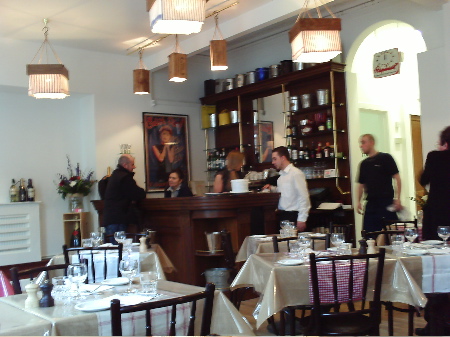
It’s a day for new beginnings. While crowds gather to welcome Obama on the other side of the Atlantic, Ray and I celebrate change with a glass of wine over lunch on the opening day of yet another new restaurant in our neighbourhood. Broughton is now surely the cafe culture centre of Edinburgh. We’re the only diners in the place so far but L’Escargot Bleu deserves to thrive.
Looking out the window it is hard to believe this is the same district we came to more than 30 years ago. Old landmarks have changed beyond recognition: the ironmongers where we bought paint and picture frames now sells organic nappies and designer clothes for babies; the post office where I queued for family allowance sells cheap dvds; the launderette is a fantastic new Italian restaurant; Just Junk’s eclectic mix of, er, junk has given way to a blooming florists, and almost every other available premise between London Street and Picardy Place is now a deli, cafe, bar or restaurant. (Simply can’t remember what used to occupy the space now selling organic sex products for women!)
I feel a moment’s nostalgia for Ritchies’s the clock makers who set up shop in 56 Broughton Street 100 years ago (and mended the old pendulum clock in our hall). But they are now in Dundas Street and we are sitting at a table in their old shop eating a delicious warm salad of leeks and celeriac. At the bar they are talking in French. If you closed your eyes you could imagine you were somewhere in Montmartre.
It’s a brave time to be opening a new restaurant and there is plenty of competition in the street, not least Bella Mbriana in the old launderette. But if today’s lunch is anything to go by they could do well. (After salad we had a very tasty coq au vin: two starts, two mains, two glasses of wine and an excellent coffee for £30). So here’s to Barack Obama and L’escargot Bleu.
Blurry pic not the result of a glass of wine – something sharper taken from the street outside will take its place soon.
[Now try Dionika offeringa three course lunch for £7.50 including the glass of very good wine.]
Last night’s meeting at Out of the Blue was cold. Like everyone else Celia and I kept our coats on and held on to hot drinks as long as we could. But the discussion at the Food Summit was so heart warming it reinforced my hunch that food (or how we grow and eat it) offers the best way out of the mess we are making of the global economy and the planet.
So while the government was deciding to coke up the atmosphere by building a third Heathrow runway a mixed bunch of allotment holders, backgreen gardeners, social entrepreneurs, community activists and voluntary groups were peeling off their gloves to vote for greener ways of growing and selling healthy local food in Edinburgh. Or to be precise, Leith. (See Greener Leith Food Summit report for fuller list of action points.)
The Food Summit organised by the very entrepreneurial Greener Leith.
Hugh Raven, Director of the Soil Association in Scotland, urged us to grow our own (organic) food or at least buy local. Pointing out the carbon footprint of intensively reared pork and chicken, he suggested we eat less but better meat. But perhaps it was the activities of small local schemes that brought most hope.
In the tea break Celia and I stamped our feet and marvelled at all this energy and enterprise; so many local groups working on low, sometimes no, budgets to improve quality of life in their neighbourhood. This is what active citizenship means but (quick rant) grassroots do need help from above to help them grow.
Perhaps that’s why so many votes went to idea that the council should employ or fund (probably not quite the same ) a Community Development Officer to help local community gardens, food co-ops etc develop their full potential.
The one with most dots is for Leith Farmer’s Market
I confess I have a personal interest in all this (not just because I am on the committee of Greener Leith who organised the Food Summit ). The recession seems the ideal incentive to change the way we do things. For months now I have fantasised about schemes that would enable people to eat better, spend less and get more fun out of cooking. So we could reduce our impact on the environment, get fitter, happier and create sustainable jobs (for me too please!) all at the same time.
Feed Four for a Fiver seemed a good slogan to sell to farmer’s markets, local shops or even supermarkets. Too late. They’re all at it now. Jamie coaxes customers to Feed a Family for A Fiver at Sainsbury’s. Asda, Morrisons and even Waitrose are all playing different variations of the same theme.
Anyway, noting the growing number of food co-op schemes in my neighbourhood which could make good stories for Leith Open Space website I went along to Out of the Blue last night. The response to the meeting was extraordinary and I hope collaborative community action will come of it. Just for the record, my votes went to the community development officer, a community orchard and a farmer’s market for Leith.
But I haven’t totally abandoned that idea of feeding four for a fiver.
This is a great farm shop, I hope to write more about it very soon.