Posts filed under 'The City Talks'
I might have known better. Getting into the taxi in Queen Street Station one rainy day I couldn’t help commenting on George Square. Looking a little tidier today, I say, but what’s happening to the statues?

Budapest statue park
Never mind the statues. The taxi driver is irate at the cost of Glasgow City Council’s proposed refurbishment of the square: “£15million and they’re cutting nearly £50 million from the city budget!” By the time we’re three sides round the square ( £3.60 on the meter) he’s in full flow. “You know what they say about our old Lord Provost Pat Lally – he was never going to get invited to Moscow so he brought Red Square to Glasgow”.
That was just days before council leader Gordon Matheson made his U turn, gave in to public pressure and cancelled the refurbishment plans which would have replaced the red tarmac and maybe even moved the statues elsewhere.
I’m keeping my mouth shut on taxi rides these days. The story rumbles on and no-one is happy with the council’s handling of the project which cost £1m in a pointless design competition. But I’m looking at those statues with new eyes. What are they for?


Designed to give you a crick in the neck
A poll showed that most Save the Square supporters could not name the statues but they wanted to keep them anyway. And I must admit my knee jerk reaction was similar when I first read about the council’s proposals for improving the square. Removing the Victorian statues seemed a kind of vandalism. On my way back to Queen Street I took a closer look.
In the cold evening light they’re a chilly bunch. Poker-faced and pigeon-spattered. A poet here, a general there, a monarch on her high horse. Nothing to catch the eye or stir the heart – none of the passion of Rodin’s Burghers of Calais, not a word about the trades union rally that filled the square and brought the tanks out in 1919.
Burns, Watson, Watt, Scott. All male, apart from Queen Victoria, and all worth remembering of course but what do they say about Glasgow, Scotland’s most ebulliently creative city?

On her high horse
This is civic art at its most predictable, a tired old imperial ego-trip. In Buchanan Street we meet Donald Dewar as another human being and smile at George Wyllie’s running clock.
So, though my taxi driver made a good point about the cost at a time of cuts, it’s a pity Glasgow city council failed to make a proper case for clearing the Victorian clutter. They could start with that monstrous Walter Scott column (and Edinburgh should banish the preposterous Dundas towering above St Andrew Square). Give us statues we can look in the eye!
Budapest did not have the same problem – once the Soviet Union crumbled they just shovelled redundant communist icons to a field on the outskirts of the city. It’s a great tourist attraction.
In an ideal world, of course, city councils would have control over their revenue so they could invest in the public realm along with maintaining essential services. But that’s another blog.

Old Soviet heroes, rust in peace outside Budapest
February 21st, 2013

My curiosity was raised by three words scratched on the empty shop window. “It’s not Tesco,” was a nicely enigmatic teaser which turns out to be true. The food store about to open in Canonmills is a very different kind of business.
“We won’t be any competition to Tesco,” says Dirk Douglas, one of the directors of Earthy Foods and Goods. Hard to tell over the phone but the comment sounds deadpan. Even so it’s a big, bold move for the organic food business which opened in a former wine store in Edinburgh’s Southside in May 2008. A small company set on growing slowly and surely has found itself taking a big step across the city because the opportunity came up. Just down the hill from Tesco.
Last year they opened their second store, Earthy Porty, in Portobello which now also serves as company HQ. But they’d had their eye on the Canonmills site for a couple of years and when the back-end lease came up recently they jumped at the chance.
“It an ideal site with a high-profile,” says Dirk, “a high street shop without being on the high street if you see what I mean.”
Quite apart from the surrounding economic gloom, the site has advantages and disadvantages: overlooking the Water of Leith but overshadowed by who-knows-when plans for a controversial property development which gained planning permission despite strong local opposition.
I’ve lived here long enough to remember an odd succession of businesses occupying the low-lying building that sits at a junction between Broughton, Stockbridge and Inverleith. The old ship’s chandlers with adjoining real ale shop became an uncomfortable looking outfitters specialising in kilts and evening wear. That didn’t last too long. Then Dionika got off to a good start with a thriving restaurant and deli but, sadly, seemed to run out of steam and customers.

The site looked blighted. Indian take-away moved to premises across the road but when the owner of the fireplace store decided to retire… along came Earthy. And that sounds like thoroughly good news for the area. Food and cafe culture seem to have developed some resilience to recession – when price, quality and location are right. (Although the Starbucks effect can be devastating as recent closure of Always Sunday in the Royal Mile shows).
Earthy, you might like to know, stands for Ethics, Appreciation, Respect (for environment and for people), Trustworthy, Hardworking… and Young at heart. If that sounds far-fetched you just have to meet the team behind the business to see that they mean it.
In fact I met Dirk Douglas and some of the team a couple of years ago when I was on a copy-writing assignment for a Glasgow PR. I went back to the store as a customer a few times – I liked the mix of seasonal food, local produce and friendly self-confidence, but going to the Southside on a shopping trip really meant taking the car and that kind of undermined the environmental benefits of buying local, seasonal food.
“A lot of our customers were asking, when can you come to Broughton? A lot more visit our website and ask can you come to Stockbridge? Come to Leeds!” For now, though, the move to Canonmills is enough. All being well Earthy – food store, take-away café and licensed restaurant – opens in early April.

March 14th, 2012

Imagine this. A warm October evening in the covered market: on the ground floor stalls packed with gleaming fruit and veg, upstairs friends gather to chat, drink and eat. We wander round, selecting small dishes to taste, secure our stools by the bar and dream about what might have been in Edinburgh’s Assembly Rooms.

Ah, if only. Inside the City Council other plans are brewing for the George Street building undergoing restoration. But come with us briefly to Madrid where the skies are almost certainly still blue and the air is warm. The metro whisks us to Gran Via, the nearest stop to the central Chueca district. Following the street map, and an email from a friend of a friend, we find the Mercado San Antón.
The new covered market is a remarkable space for several reasons. Not least (if my Spanish is any way correct) because this shining emporium, completed this year, came in more than €3million under budget (Edinburgh please take note).

The building itself, squeezed into a bustling network of narrow streets full of small shops, is clearly not to everyone’s taste. Probably Madrid (observing the MAD in Madrid) likens it to the worst of British municipal architecture of the seventies
But others (see guiriguide) welcome the new market – there was an old dilapidated building on the same spot – as a contemporary twist to the city’s mercado tradition. Our friend of a friend is obviously among them:
Inside there are many stalls where you can try small portions of lots of different kinds of food and cheese and wine – very much like the Mercado San Miguel off La Calle Mayor – but bigger, there are 3 floors, and a huge roof terrace. You can take your food and drink and eat inside or outside. It is not as busy as San Miguel so you can at least sit somewhere!
We didn’t spend much time looking at the architecture, we were more intent on finding what was inside. The roof terrace was full so we retreated to the second floor and spent a happy half hour tasting cheese, chorizo and anchovies with a glass (ok, two glasses) of chilled white wine.

The roof terrace at a quiet moment earlier in the day
Imagine, we kept saying, what you could do with a space like the Assembly Rooms. Bring the Farmers’ Market indoors? Invite new and traditional enterprising local producers from in and around Edinburgh to display their skills in the city centre? Encourage a multicultural market to celebrate Scotland’s growing diversity?

Ah, if only. It’s all too late of course. Back home in Edinburgh, rolling along George Street in a bus on a cold October evening, we look out of the windows counting the succession of bars, bistros and restaurants sliding by: Gusto, Browns, TigerLily, CentoTre, The Living Room, Cafe Andaluz. Is Assembly Rooms really the best location for Jamie’s Italian?
The City Council has decided. Our fantasy covered market will have to find another location. Leith maybe?
October 20th, 2011

The philosopher’s toe: pictures by Andrea McCarthy
Looking back it was a prophetic moment though I did not know it at the time. Almost 14 years ago I covered a Scottish Enterprise conference on the future of Scotland. US futurist Joe Coates, grey and spindly as a heron, stalked the stage and talked about the potential of mobile technology using language most of us hardly understood. What future tourists would want, he said, was a digital companion they could carry in their pockets providing all the information they needed to know about any given place.
In 1997 I didn’t even possess a mobile phone. Now here I am, a director of a brand new media company creating one of those digital companions – or rather, the information that can be loaded on to it.
A roll of good old fashioned drums please. Walking Heads Ltd launches our first downloadable audio walking tour during Edinburgh’s Fringe. At one level Edinburgh Comedy Tour can be taken as a Fringe show (and there are others using digital technology this year) but our 90 minute walking guide includes many layers of information. Just like Joe Coates predicted, it is full of facts people like to know when they visit a new place: where to go, what to see, how to get there. But there’s a difference. With a nice poetic twist, Walking Heads has won a Scottish Enterprise Tourism Innovation Fund award because we promise to take people off the beaten track to reveal the true grit of the place.
So Edinburgh Comedy Tour is a mix of history and folklore, comedy and spicy gossip and I feel it captures the odd Jekyll and Hyde nature of Edinburgh much better than conventional guidebook or guided tour.
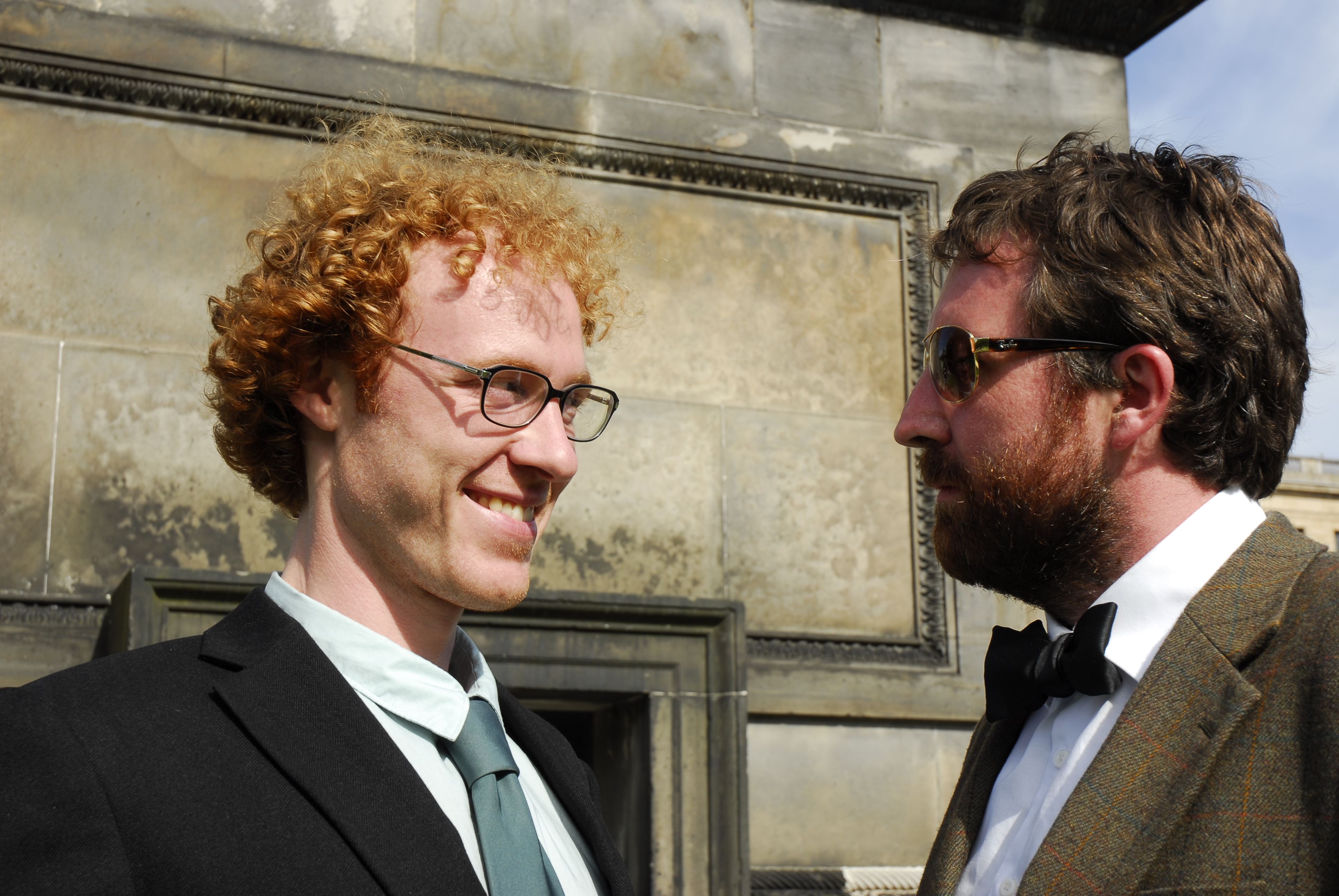
Harry Gooch and Jamie MacDonald
With wicked ingenuity our comedian scriptwriters Jamie MacDonald and Harry Gooch have created a surreal narrative that leads you round Fringe comedy venues while developing a dysfunctional but affectionate relationship that leaves you (or me anyway) close to tears at the end. And in the process, with nicely paced navigation from Dougal Perman and incidental anecdotes from comedians Bruce Morton and Susan Morrison, you learn a great deal about the fur-coat-and-no-knickers side of Scotland’s capital. The extra twist to this tale is that Jamie is blind and his running refrain, ‘Be my eyes Harry’, deserves to be a Fringe catchphrase.
Back to the future. We’ve only just begun. We’re learning a huge amount as we go and we have a lot more to learn yet. But already we demonstrate something else that Joe Coates predicted. In the future, he said, companies will be like the film industry: collaborative and infinitely flexible co-operatives, constantly forming and re-forming to share expertise according to the needs of each product.
Unlike a film company, we don’t have best boy nor grip, hairdresser nor continuity girl (though we could do with the hairdresser at times!). But, straddling Glasgow and Edinburgh, Walking Heads is a mosaic of technical and artistic creative talent, buzzing with an enthusiasm that would put big corporations to shame. Of course I am biased and very proud to be part of it.
Since we are a collaborative team, I’m leaving the selling part to other members but I would be mad not to invite you to download Edinburgh Comedy Tour as your absolutely essential companion to this year’s Fringe. At £3.49 for MP3 and £3.99 for the App and Android – that would have seemed cheap back in 1997!

August 15th, 2011

Ray Perman’s recent commentary on Leith Walk prompted Ross Armstrong to put down some thoughts about how to improve Edinburgh’s most interesting boulevard (but first he measured it on Google maps).
The amazing potential of Leith Walk strikes me every time I walk down it. It’s a great big boulevard that feels like it’s going to waste. Perhaps because the potential is so obvious to all, it’s always been assumed it will fulfill it eventually on it’s own.
It has history, architecture, excitement and an edge to it, so it’s not that strange to compare it to Las Ramblas, and it’s actually longer (1.6km long as opposed to 1.2km), so there’s plenty of space to work with. This is most likely the biggest problem – because of it’s sheer size it is hard to manage coherently – so it’s perhaps unsurprising the council treat it just like any other big road. However, I believe this is a significant street, and it needs sympathetic improvements, not just box ticking efforts required to make it a functioning dual carriageway.

For starters: one of the big problems I see is clutter. It’s got to be one of the most cluttered streets in Edinburgh. Things off the top of my head that could go:
The aforementioned “ugly metal shutters”, and “garish keep left signs”, and excessive signage in general.
Those Tram adverts, just insulting now.
Cut down on phone boxes, there are loads of them and they’re hardly used these days.
Cut down on bike racks- these are all over the place. (It seems like there was money for these at some point and the council went crazy! They look like they’ve been placed randomly and most are rarely used from what I can see.)
Bins of every shape size and colour, perhaps more effort should be put into standardisation and concealment.
Bus ticket machines. Fail.
Speed cameras, I can think of at least two, they look terrible, take up space on the pavement, and are they really necessary?
Shop signs in the street should be tightly regulated.
“Feeder pillars” or what ever they are called, I’m sure some of these mysterious metal boxes on the pavement are redundant, in some places on Leith Walk there are 3 right next to each other, seems unnecessary. I’ve heard of these being plonked out without prior warning, this certainly shouldn’t happen.
Replace broken bollards/railings, or just get rid of them.
Sell all this for scrap and buy some trees!!
[Many thanks to Ross who kindly let me use his comment on Ray's blog as a stand alone post. He will soon be receiving a copy of Prospect magazine featuring Sir Terry Farrell's design challenges for Edinburgh – including Leith Walk's potential to become Edinburgh's Ramblas]

July 19th, 2011

Flashback to the successful Friends of the Earth Scotland campaign 2007
“A great city let down by its elected representatives”, BBC Scotland environment and science correspondent David Miller sums up last night’s Newsnight Scotland tram story, possibly the best news coverage so far of this extraordinary mess. The thunder is still rumbling around the city today and it has a long way to roll yet.
But last night’s story asked some very important questions. Not least, where is Jenny Dawe, city council leader. As Miller said last night, if this was happening in London you can bet Boris would be all over the media.
Edinburgh’s media does have some questions of its own to answer. The Evening News has consistently focused on the myths and mischief making of politicians with a party axe to grind. Where was the journalistic investigation into the contract, where the forensic analysis of budgets, where the curiosity about the contractors? How have Bilfinger Berger managed to complete other projects around the world without this difficulty and is it true that the Scottish government has placed a gagging order on the company?
Today as Alex Salmond grants a public enquiry, the city council is faced with the official version of that leaked report claiming it will cost more to scrap the tram than carry on. So the Evening News has published poll results claiming most people in the city want to scrap the tram. Like all polls it begs more questions than it answers. I for one am passionately in favour of the tram. But like most people I know (whether for or against the tram) I cannot understand how the project has become such an extraordinary disaster, or who is to blame. (And I am not at all sure a public enquiry is the best use of public cash).
Apart from lack of leadership and gobsmacking inefficiency, my main criticism of the council is that it has utterly failed to present an inspiring case for the tram. It shouldn’t be difficult. The tram is a fast and energy-efficient way to connect communities across a city with a growing population; it increases social mobility and reduces congestion, air pollution and carbon emissions. These are benefits which should suit the green claims of the Scottish Government. Now the SNP represents so many urban constituencies maybe the tram could begin to look more attractive?
They (and the Evening News) might take a look at Linkedin where Edinburgh Chamber of Commerce has been conducting a civilised and balanced debate with many good reasons for not scrapping the tram. Even as I write a wonderfully sane and intelligent discussion is live on the Better Nation blog. With luck some of the writers will stand for election to the city council next year!
June 23rd, 2011

What makes the concept of World Heritage exceptional is its universal application. World Heritage sites belong to all the peoples of the world, irrespective of the territory on which they are located UNESCO World Heritage website
So who owns the New Town? The morning after blogging about the bin bags of the New Town, I am strolling along Regent Terrace enjoying the view when I find a pile of rubbish not far from the American Consulate. As it happens there’s a group of tourists right behind me, “What a mess,” says one of them, warily stepping her way round the grot.
Coincidentally Ray was taking a picture of a pile of bags in Great King Street (below) demonstrating an attempt to prevent scavenging gulls ripping them open before the bin men get there.
Why should I care? I don’t live in Great King Street or Regent Terrace (above) where ‘kerbside sacks’ are collected on Mondays and Thursdays. I live on the edge of the New Town (even that phrase can add a few quid to value of a property ) where wheelie bins are emptied once a week.
But, at the risk of sounding obsessed, I think there are two reasons why New Town rubbish is a public issue. The first is a matter of pride. To quote UNESCO, the world heritage site belongs to all of us. Besides, Edinburgh’s World Heritage status is exploited as a tourist attraction. Tourists are encouraged to explore the elegant New Town to admire the 18th century architecture and streetscapes that had a major influence on European town planning. At present the streets don’t look so pretty on Mondays and Thursdays.
The second is more serious. At a time when council tax is frozen, when council services are up for privatisation, when funding is withdrawn from support to the most vulnerable people in our city – in short, when every penny counts – then it is simply wrong to waste money on twice weekly collections plus the extra costs of clearing up after spilt bags. Oh go on, accept communal wheelie bins, they won’t look any less aesthetically pleasing than parked cars, and a whole lot better than garbage!

Black canvas sacks hung on the railings in Gt King St, emails Ray, an attempt to beat the foxes and seagulls no doubt. But some residents still use bin bags.
June 5th, 2011

Oh contrary Edinburgh. While the people of Leith Walk are (rightly) angry with the council for messing up their street (see comments on Ray’s recent ‘rant’) round the corner residents of the posh New Town are turning their neighbourhood into a tip all by themselves.
In fact they seem determined to prevent the council from keeping their streets neat and tidy. Up the West End, according to the Evening News, householders are manning the barricades to stop the council supplying communal wheelie bins which would keep their rubbish in the right place.
Good to know Auld Reekie gets priorities right: we let bankers away with daylight robbery but take to the streets to prevent the council delivering waste bins.
Black bin bags are so much more acceptable in the parts of town where properties fetch an eye watering price (even during the recession). To be fair, Edinburgh New Town is not the only urban area to resist the arrival of the wheelie. A quick online search brings up newspapers across the UK making rubbish puns about community campaigns opposing the wheelie bin. Sometimes they make jokes without realising it: the Wimbledon Guardian (as read on BBC Radio 4 News Quiz) reported a local councillor protesting “It is nonsense to say we are trying to bring wheelie bins in by the back door”.

In Edinburgh the argument seems to be that New Town dwellers couldn’t get the bins in by the back door or out the front door either. They simply have no room for bulky bins inside or outside their well proportioned Georgian buildings. And, oh dear, communal bins in a heritage site would be far too common.
So these fine flats and houses insist on putting their rubbish out in black bags for hungry foxes and gallous gulls to rip open in search of a ready meal (imagine their disappointment on finding underwear instead) and it gets spread all over the pavement. Lovely.

The May issue of the Broughton Spurtle reported a council plan to introduce a pilot scheme for waste collection – some bins, some (gull proof) bags, some communal skips. I feared my picture of the bra might become outdated before I got round to posting it but I needn’t have worried. It does look as if garbage guerrillas are intent on keeping up the fight. Its none of my business – unless of course my (frozen) council tax is helping to pay for the extra cost of picking up their rubbish each week. But I can’t help wondering what they did before the arrival of the black bags in the days when we all had dustbins.

May 30th, 2011
Ray Perman takes a critical look at Leith Walk in this guest blog. With imagination and a little money it could become the most elegant and cosmopolitan street in Edinburgh. [Many local people agree, see the excellent comments at the end of the post]

There are a lot of reasons for despairing at the dysfunctional political leadership of City of Edinburgh Council, but the degradation of Leith Walk surely comes top of the list.
This wide and noble street was conceived as an elegant boulevard connecting the newly built Georgian New Town of Edinburgh with the prosperous and bustling burgh of Leith. William Stark, the 18th century architect and planner, commented on the “fine double row of elms” extending for 200 yards down the Walk. His colleague, William Playfair, who designed Leopold Place, just off the Walk on London Road, spoke of “the happy union of foliage and building.”
Despite two centuries of piecemeal development, there are still some fine buildings along the Walk, but the council has turned it into an urban clearway, so there is no incentive to stop and look. An excess number of garish yellow keep left signs are now the main feature of the street. What are they for? Does the council seriously expect that motorists would drive down the wrong side of the dual carriageway if they weren’t reminded every 25 yards?
The Walk is wide enough to have a broad central reservation with shrubs and trees – like the one which runs along the broader part of East Claremont Street. But what do we have instead? The cheapest, nastiest black rubber blocks, bolted together. If they weren’t ugly enough, they are flanked by unnecessary white lines, hatched on the road. For what? To deter motorists from parking in the middle of the road?
The whole effect is ghastly, but just think what Leith Walk could become. With imagination and a little money, it could again be an elegant thoroughfare with broad pavements, street cafés, trees and shrubs. It is the most multicultural street in Edinburgh and could also be the most cosmopolitan.
The Walk had to put up with two years of disruption while the street was torn up for the trams which – thanks to the council’s incompetence – will now probably never traverse it. It deserves better than the fate the council has decreed for it.

May 2nd, 2011
I see the Guardian is asking for memories connected with the Scott Monument. This probably isn’t what they are looking for but I can’t resist publishing a provocative piece which first appeared in The City Talks. Colin Cumberland makes a pretty good case for getting rid of the monument which he describes as a “Gothic plook” and a “crumbling carbuncle”.
Colin, then managing director of Applecross Properties, began by comparing the two sides of Princes Street to the anti-smoking campaign which uses two sides of a face to show the ill-effect of smoking: one side haggard and slack jawed the other bright eyed, clear complexioned and youthful. He continued…
“Visitors to Princes Street will recognise the imagery. On one side there’s beauty, elegance and vitality; on the other, neglect, self-indulgence and drabness. But the comparison can be overplayed: whilst the model in the advert has an unblemished good side, Princes Street’s better half has to contend with that Gothic plook, the Scott Monument.
“Just to remind you, the Scott Monument was a result of a competition. The winner, George Kemp, was initially placed a rather distant third but the judges could not make up their minds and, after requesting further designs, Kemp was declared the winner.
“Kemp, a joiner to trade, borrowed bits from Melrose Abbey, Glasgow Cathedral and Antwerp Cathedral. This Gothic confection sits in East Princes Street Gardens, a decaying and pointless homage to unrestrained vulgarity.
“What does it do? What is its function? How do people use it? These are legitimate questions to ask of all the buildings along Princes Street but the Scott Monument delivers no satisfactory answers.
“I notice the theme in this City Talks is the importance of public spaces. Could I suggest that the City Fathers’ contribution could be demolition of the Scott Monument to release a chunk of the Gardens which citizens of Edinburgh could then really enjoy? The sculpture of Sir Walter himself is rather well done and I would be happy to see that remain. But for the rest, get rid of it.
“Princes Street has too many buildings which are not fit for purpose. If Princes Street is to be a world-class street then we have to create new buildings with big floor plates for trading. The new buildings could be completely commercial but we have got to get away from shops trading out of ground and first floors leaving three or four upper floors stacked high with scabby cardboard boxes for all the world to see. As a residential developer I would, of course, prefer some flats over the shops to ensure the centre of our beautiful city is lived in and remains an exciting vibrant place after the shops have closed for the evening.
“I don’t think I have singled out the Scott Monument unfairly. The problem with redeveloping Princes Street is the multiplicity of ownerships and competing interests so it is difficult to know where to start. The Scott Monument is in single ownership with a single interest. Come on. Be brave. Be visionary. Demolish this crumbling carbuncle to demonstrate that we are happy to embrace the possibilities of the future, rather than being trapped in the complacency of the past.”
Footnote: great rousing stuff from Colin. Sadly, Applecross Properties went bust in May 2009 but the Scott Monument is still there. (By the way I produced The City Talks newsletter for the former Edinburgh City Centre Management Company in 2006).
December 29th, 2010
Previous Posts